Last month Google announced a new addition to its website’s Transparency Report.
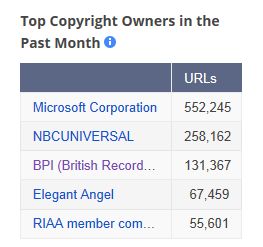
Google has decided to release information on the number of requests it recieves from copyright owners (and the organizations that represent them) to remove Google Search results that allegedly link to infringing content.
Google’s senior copyright counsel Fred von Lohmann writes on Google’s blog, “We believe that openness is crucial for the future of the Internet. When something gets in the way of the free flow of information, we believe there should be transparency around what that block might be.”
Last month Google announced a new addition to its website’s Transparency Report. Google has decided to release information on the number of requests it recieves from copyright owners (and the organizations that represent them) to remove Google Search results...
Last week President Obama’s campaign committee, Obama for America, filed a trademark infringement lawsuit against an online vendor, DemStore.com, for allegedly using the campaign’s trademarked logo without permission. The campaign sent DemStore.com two “cease and desist” letters last year, but the company did not stop using the logos. DemStore has sold merchandise supporting Democratic candidates since 1985, and currently sells Obama election merchandise bearing two logos that belong to Obama for America. The two logos at issue are the “Rising Sun” logo, which Obama for America has owned under a federally registered trademark since 2008; and the “2102 Rising Sun” logo, for which it has a pending federal trademark application.
Last week President Obama’s campaign committee, Obama for America, filed a trademark infringement lawsuit against an online vendor, DemStore.com, for allegedly using the campaign’s trademarked logo without permission. The campaign sent DemStore.com two...
Over the past decade, websites and Internet Service Providers (ISPs) have learned to rely on the takedown procedures of the Digital Millennium Copyright Act (DMCA) in order to generally avoid copyright infringement liability imposed by content owners.
ISPs have been able to shield themselves from all liability form their users posting infringing material by having a proper takedown system in place. But, a recent Second Circuit case undermines that level of confidence in takedown procedures.
The Second Circuit Court of Appeals is the first U.S. court to decide that ISPs may still be liable for copyright infringement even after complying with the takedown provisions of the DMCA.
Over the past decade, websites and Internet Service Providers (ISPs) have learned to rely on the takedown procedures of the Digital Millennium Copyright Act (DMCA) in order to generally avoid copyright infringement liability imposed by content owners. ISPs have been...
A German court ordered Google to install filters on its YouTube services in Germany in order to detect and stop people from accessing copyright infringing material.
While not holding Google fully liable for the uploaded material, Judge Heiner Steeneck did say that the company needed to do more to stop violations. The court order issued on April 20, 2012, however, is for Google a happy departure from the request made by GEMA, the German association that imposes and collects royalties on recorded media. GEMA had demanded that Google sort through its entire online music archive and remove all copyrighted material from its system. The judge rejected the request.
A German court ordered Google to install filters on its YouTube services in Germany in order to detect and stop people from accessing copyright infringing material. While not holding Google fully liable for the uploaded material, Judge Heiner Steeneck did say...
Earlier this year, the Federal Circuit found the COACH mark for famous American handbags to be not famous enough to oppose a similar mark that an educational testing preparation company sought to register. In trademark law, a trademark owner generally has to prove the likelihood of consumer confusion in order to successfully oppose another’s use or registration of a similar mark. This usually means that the two companies will be competing in the same line of business or in related markets. However, those whose marks are famous enough can stop another from registering a similar mark, even if they are not likely to confuse consumers or even run into each other in the marketplace. This is what Coach, the luxury handbag and accessories designer, attempted to do. It brought a dilution claim saying that those who saw the advertising of the Coach testing prep company might not confuse it with the company’s trademark COACH for handbags, but that the use by the testing company was likely to blur or tarnish (to “dilute”) the famous mark of Coach handbags.
Earlier this year, the Federal Circuit found the COACH mark for famous American handbags to be not famous enough to oppose a similar mark that an educational testing preparation company sought to register. In trademark law, a trademark owner generally has to...



Recent Comments